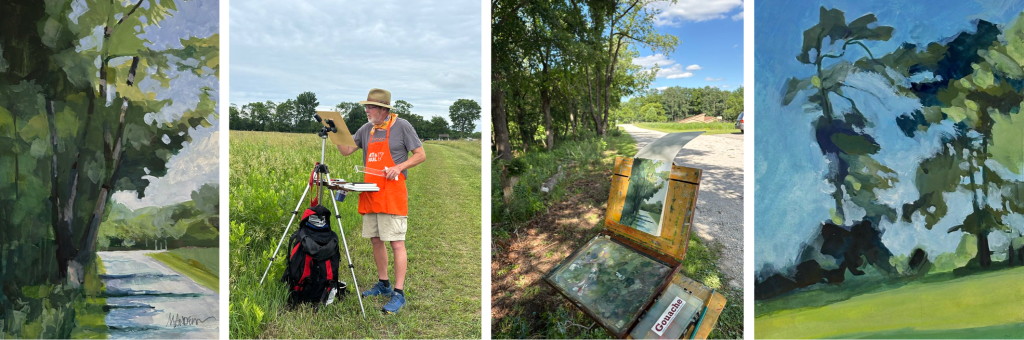
With the plein air competitions wrapped up for now, I’ve been using June to paint for myself.
Painting on location forces me to work quickly while sharpening the technical skills needed to capture the visceral feeling of a place. I’m always surprised by how different the world looks in person compared to a photograph. Cameras flatten values and often shift color temperatures in subtle ways. Standing in a place, though, you experience the full range of color, light, atmosphere, and sound all at once.
The constantly changing light also forces decisions. There’s no time to chase every detail. Complex forms have to be simplified. Unnecessary information gets edited out. What’s left are the essentials: light and shadow, shape and color.
For many artists, plein air sketches become invaluable references for larger and more detailed studio paintings. That’s a perfectly valid approach, but it’s not my primary interest. What draws me to painting outdoors is the experience itself. The act of being present in a place and responding to it in real time. I often describe plein air painting and urban sketching simply as “being there.”
One thing I’ve discovered is that painting urban scenes and painting landscapes have more in common than you might think. The common element is people.
Even when I’m set up in a remote field or along a quiet trail, people inevitably appear. And they’re often fascinated by the sight of an easel, brushes, and paint. They want to know what I’m working on and how the process works.
A few days ago, I was painting at a nearby nature preserve. Trees lined a gravel road, and I had settled in to work when an SUV came rumbling toward me in a cloud of dust. The vehicle stopped, and a man stepped out to see what I was painting. We ended up talking for quite a while. He turned out to be the caretaker of the preserve and was genuinely excited to see someone painting what he affectionately called “his trees.”
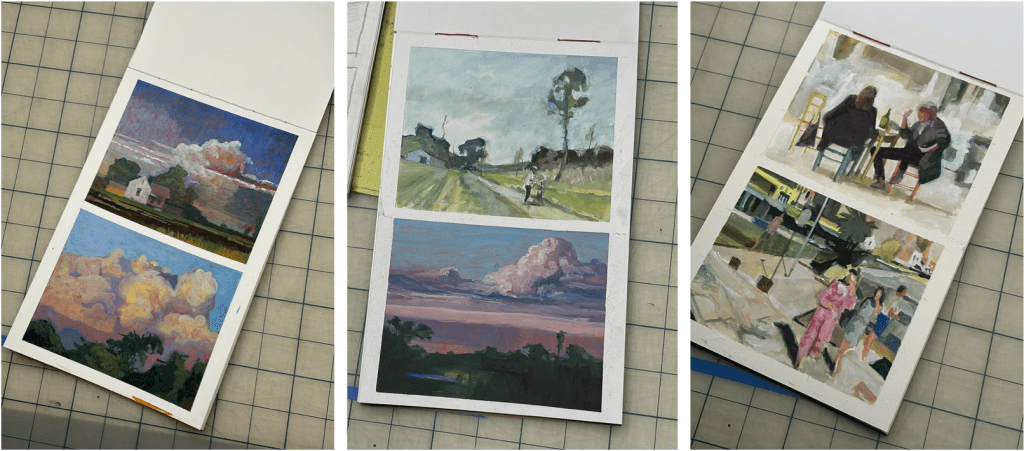
Not long after he left, two young women emerged from a trail across the road. They wandered over and began asking questions about painting nature and painting on location. Like most visitors, they wanted to see the painting in progress. I warned them that they were looking at what artists often call the “ugly middle stage”—that awkward point where a painting seems determined not to cooperate.
Fortunately, I was working in a sketchbook I’d bound with Fabriano Hot Press watercolor paper, so I could also flip through several completed pieces. They were especially drawn to some recent paintings featuring dramatic skies and cloud formations.
Encounters like these are one of the unexpected pleasures of painting outdoors. I head out looking for interesting light, shapes, and colors. Along the way, I often find conversations, stories, and connections with people who are curious about the process. Those moments become part of the experience too. They’re another reason I enjoy simply being there.


 Mark Alan Anderson
Leave a comment