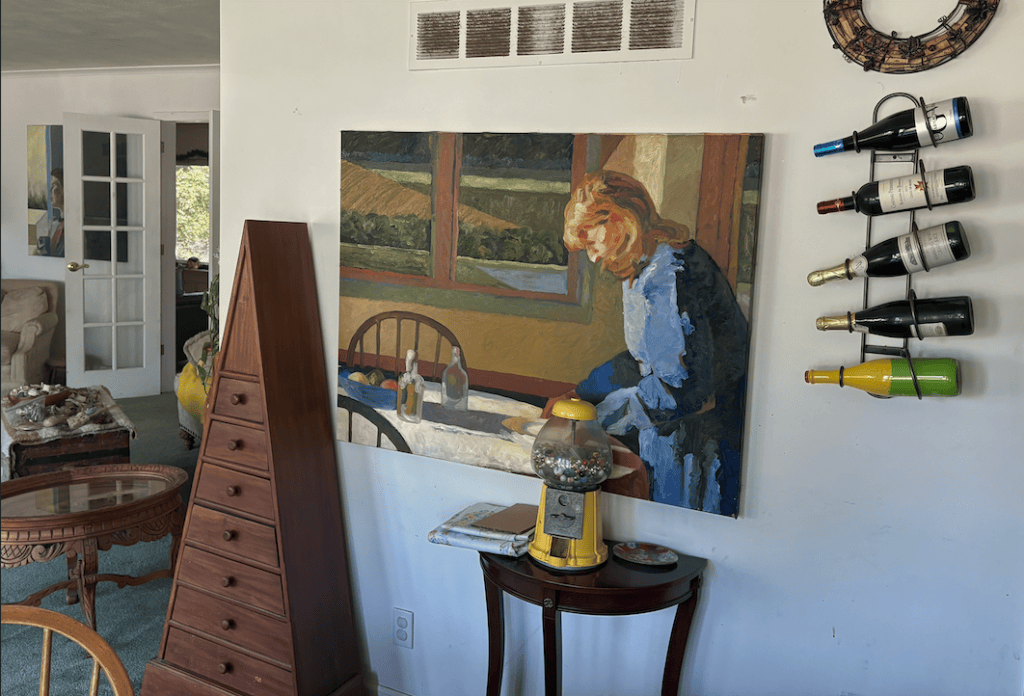
Three fairly large paintings hang in my living room. I painted them more than twenty-five years ago. Every once in a while I stop and look at them.
Recently I noticed something I’d never really thought about before: I’m still using many of the same pigments today that I used when I painted those three pictures. The big difference is that I use far fewer of them.
That might seem a little backwards. After all, wouldn’t more colors give a painter more possibilities? I’ve come to think the opposite might be true. A limited palette doesn’t necessarily limit a painting. In fact, I find it surprisingly freeing. When I have twenty colors sitting in front of me, there’s always the temptation to ask, “Which one of these is the right color?”
With a limited palette, that question mostly disappears. Forget trying to find a tube of paint that most closely resembles whatever I’m looking at. I’m thinking instead about relationships. Is this shape lighter or darker than the one next to it? Is the color more saturated or less saturated?
A tree doesn’t rely on a tube of green paint. A stop sign doesn’t have to be fire engine red. And shadows certainly don’t have to be blue. The color of any one thing is affected by everything around it.
A friend once described my approach as relational rather than categorical. I like that.
Instead of thinking, “That is green,” I’m thinking, “That is greener than this.” Instead of asking whether I’ve mixed the correct red, I’m asking whether the red I’ve mixed works in relation to the colors surrounding it.
Convincing value is the backbone of a painting. Color can be seductive, and it’s easy to get distracted by it. We see a particular blue in the sky or a particular green in a tree and want to reproduce it. But if the values are wrong, the painting usually won’t hold together no matter how accurate the colors are. A limited palette forces me to deal with that.
And, as I was reminded yesterday while struggling to make a small study work, it also forces me to be more deliberate. There are fewer places to hide. Every mixture matters. Every value really matters. Every decision is deliberate.
In a way my palette becomes a small laboratory. A limited palette means individual pigments are infinitely more consequential. The personalities of each pigment is something with which I become more intimately familiar, simplifying my response to a subject.
And because every color in the painting comes from that same small family of pigments, something else happens almost automatically.
Harmony: There’s a kind of shared DNA running through the painting. The colors feel as though they belong together because, in a very literal sense, they do.
And although I don’t consider myself a Tonalist, a limited palette gives me permission and the power to lean into Tonalism when it is appropriate.
There’s also a wonderfully practical benefit to all of this. A small palette means a small painting kit. And a small painting kit means less stuff to carry.
Tubes of paint are surprisingly heavy. Add brushes, water, a sketchbook, paper, easel, palette, and all the other little things that somehow accumulate in an outdoor painting kit, and suddenly you’re hauling around what feels like a small camping expedition.
Every tube I can leave behind means I’m a little more mobile. I like that. I can walk farther. I can change locations more easily. I can decide at the last minute to paint from somewhere I hadn’t planned on visiting. There’s something wonderfully satisfying about being able to go into the field with a small painting kit, and knowing that I have enough.
The real appeal of a limited palette for me is that it’s not primarily about limiting color. It’s about limiting choices.
When there are fewer choices in front of me, the important choices become clearer. I can spend less time deciding which color to use and more time deciding what I actually want the painting to say.
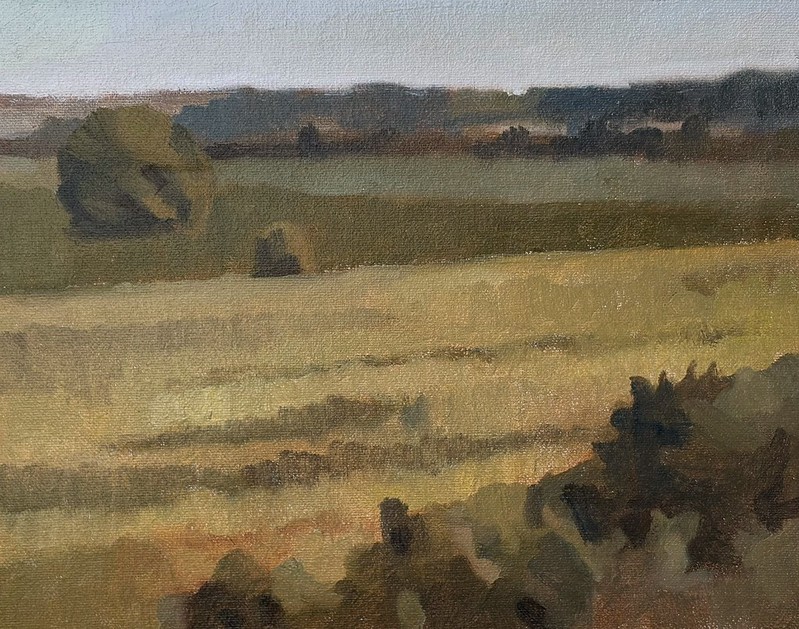
Main illustration: Late Summer, 10 x 8 inches, oil on unstretched canvas.


Leave a Reply