The heat has finally broken, I think. I hope.
I am so relieved to see a forecast showing lows in the 50s and highs in the 70s. 95 to 100 degree days have nearly broken me. And that doesn’t even acknowledge the flippin’ humidity. It’s one thing to be hot; it’s another thing entirely to feel like it’s difficult to actually breathe.
I’ve done very little in the way of hiking over the past month. A mile or two is about all I can muster before I feel compelled to crawl back into the air-conditioned comfort of the house.
Talk about a first-world problem!
My fingers are crossed that the Mill Creek Nocturne this past Friday night was the last uncomfortably hot plein air competition of the season. Now I can look forward to leaves falling, sweatshirt weather, blue jeans, much longer hikes, and probably a few showers—followed, of course, by several months of winter, which I will also bitch about when it arrives.
That’s the way it goes.
The Mill Creek Nocturne is part of an annual weekend plein air event, and nocturnes are a different animal from most quick-paint events. Light is constantly changing under even the best plein air conditions, but during a nocturne the light doesn’t simply change. It disappears.
Buildings turn into dark silhouettes. Isolated portions of architecture that were in dense shadow only a few minutes earlier are suddenly illuminated by artificial light. Street lamps begin to glow, standing in sharp contrast to the dense, inky darkness of trees and buildings. Vehicle headlights glare and throw long, surprisingly bright reflections across dry pavement. As the gloaming gives way to night, little pinpoint highlights begin to emerge everywhere.
And the sky changes almost by the minute.
It starts with the drama of sunset and whatever clouds happen to be passing through. Then the color begins to drain away, leaving a dark mass that gradually shifts from a low, hazy glow near the horizon to almost complete blackness overhead.
It’s a lot to keep up with.
One thing that always strikes me is how warm so many of the artificial lights are. Streetlights, windows, headlights—they all begin turning the scene toward warm oranges and yellows as the evening progresses. But by the time that becomes obvious, I’ve already made a lot of my color decisions.
And I’m not changing them.
At least not much.
I’ve placed those colors earlier in the process, when the light was different, and I’m generally happy with what I’ve got. At some point you have to stop chasing reality and let the painting become its own thing.
That’s probably one of the things I enjoy about painting outdoors. I’m trying to respond to what’s in front of me, but I’m not attempting to make a photographic record of every change that happens during the two or three hours I’m standing there.
I try to remember to photograph the process as I go, too. I say try because, as usual, I don’t take nearly enough progress photos. The few I do have, however, show just how dramatically the scene changes between the beginning and the end.
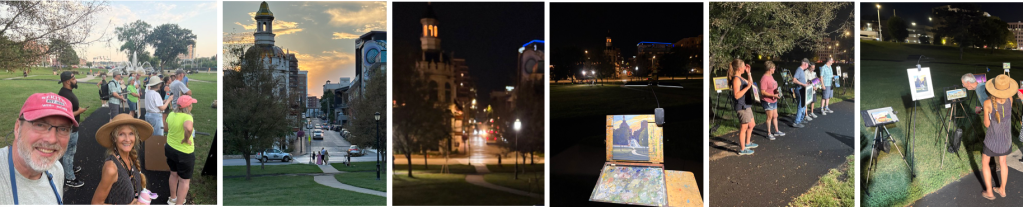
There were, I believe, about fifty artists registered for the weekend event, with perhaps forty of us in attendance for Friday evening’s kickoff. We lined up to have our canvas, paper, or boards stamped, officially marking our work for the timed event. Some artists had already scouted out their locations. I noticed a couple of friends had their easels set up and were already painting before I even arrived.
Some of us—including me—had made a few thumbnails beforehand. (And then abandoned them completely.) I wandered around the park looking for a view that offered some sky, some promise of silhouettes that might suggest the iconic Spanish architecture of the Plaza, and a few useful leading lines.
In past events I’ve tried setting up farther down the street in the more commercial and bustling parts of the Country Club Plaza. I’ve yet to come up with a composition down there that didn’t strike me as either trite or something that had already been painted and photographed to death.
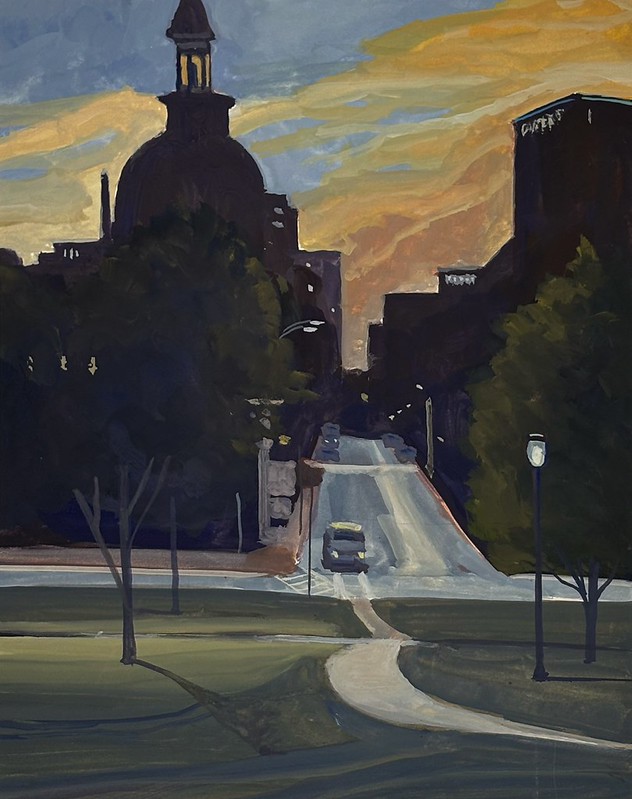
This time I decided to look in the opposite direction. I settled on a much quieter, much less trafficked view of the back of the Plaza, seen from a slight hill in Mill Creek Park. It wasn’t the obvious view. That was part of the attraction.
There was enough architecture to identify the place, but not so much that the painting became an architectural portrait. There were trees and dark shapes, a bit of sky, some light, and a few good lines leading through the composition. That seemed like enough to get me going.
One of the things I’m particularly thankful for during a nocturne is the portable light I attach to my Open Box M pochade box. It’s actually a light designed for musicians, I think, but it happens to be nearly perfect for painting at night. It has multiple power settings and an adjustable color temperature, so I can get enough light on the board and mixing area without turning the whole setup into a small landing strip. And it has another useful feature: when the painting is finished and framed, the same light doubles as a display light.
As the evening got darker, I found myself simplifying more and more. That’s almost unavoidable. Details disappear. Shapes merge. The distinction between one object and another becomes less important than the overall arrangement of darks and lights. And I rather like that. I’m interested in what happens when I have to make decisions about what matters, and a nocturne forces those decisions.
By the end of the evening, the place I had started painting wasn’t really the place I was looking at anymore. The Plaza had become a collection of dark shapes, warm lights, reflected light, silhouettes, and a little remaining color in the sky. The actual scene kept changing, but the painting had to stop at some point.
Friday Night in the Big Town, 8 x 10 inches, gouache on board. I hate coming up with titles for paintings. This old catch phrase used by, I think, sports commentator Mitch Holthus popped into my head, and for once I didn’t have to torture myself trying to invent something clever.
The heat definitely made the evening uncomfortable, and the changing light certainly complicated the process, but once I got settled in, I was reminded again why I keep doing this. You stand in one place for a couple of hours and watch the world change. The painting changes with it. People come and go, many stopping to see the painting and to chat. Lights come on. The sky darkens. Shapes disappear. Other things suddenly become visible. And eventually you have to put the brush down and call it a day (or in this case, an evening), even though the place itself keeps going.
Maybe that’s the real challenge of a nocturne—not trying to capture the night exactly as it is, because by the time you’ve painted it, it isn’t that anymore. You just have to be there long enough to see what happens and paint what you can.
 Mark Alan Anderson
Leave a comment