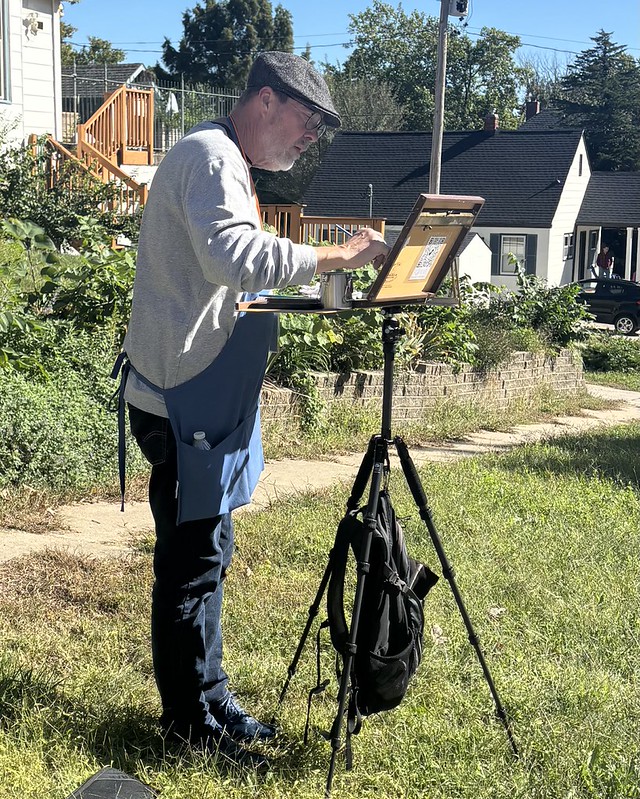
A little over a week ago, I found myself wondering if the rain would stop—or at least pause—before the plein air event kicked off in Excelsior Springs the following day.
It had been raining on and off, and the air was considerably cooler than it had been earlier in the month. During one of the breaks in the weather, we took a long drive out into the country to relocate a raccoon that had been breaking into the studio. Apparently, the little bandit had developed a taste for kitty treats.
It was a long drive, but not a wasted one.
Somewhere along the way I discovered some really attractive stretches of land that I hadn’t been aware of before. We took a few previously unknown turns, followed some hills and back roads, and generally wandered around. It was actually a pretty good way to get myself into the right mindset for painting small-town Missouri the following day.
And if it rained on the morrow?
Well, I figured I could always set up in the back seat of my truck if necessary. I mean, hey! Didn’t Edward Hopper and his wife do something similar in their station wagon? Not a bad model, right?
Fortunately, I didn’t have to resort to that.
I’ve been thinking lately about how often I arrive at a place with a preconceived notion of what I’m going to paint before I’ve actually arrived. Excelsior Springs was a good example. I’d scouted locations ahead of time and already had a pretty good idea of what I wanted to try.
That’s not necessarily a bad thing. Scouting is useful. It saves time, especially when you’re working under the clock.
But it can also be a trap.
If I become too committed to the composition I imagined beforehand, I can end up forcing the place to conform to the painting I had already decided to make. And in doing that, I can easily overlook what’s actually there.
My first painting followed my preconceived plan. I focused on a cool Victorian house and thought I had found a pretty good composition. It seemed to be going really well.
Until it wasn’t.
That’s one of the more frustrating things about plein air painting. You can put a lot of time and effort into a painting only to realize somewhere along the way that it’s not going anywhere. There isn’t much you can do about it except finish what you can, learn something from it, and move on.
I completed and submitted three paintings for the event. The rain held off, and the day unexpectedly turned out to be quite beautiful.
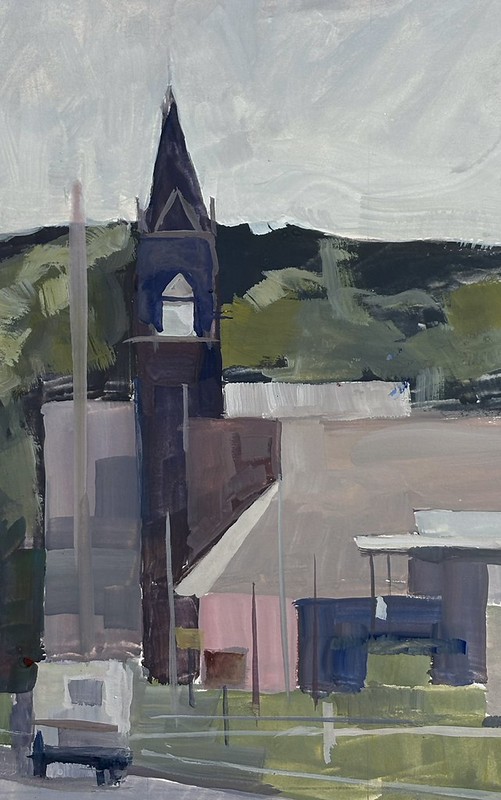
The second painting was also based on something I’d discovered while scouting, but this time I tried to give the location a vote. I had some preliminary sketches I’d made beforehand, but when I actually arrived, I took a little time to be curious about the place itself—the old Catholic church and the surrounding neighborhood.
And that’s when I started noticing something I hadn’t really seen in my preliminary sketches.
The neighborhood was a patchwork quilt of interesting architectural shapes. Rooflines, porches, trees, streets, houses, bits of sky. There was a lot going on, but it wasn’t chaotic. It was a collection of shapes and relationships that appealed to the designer in me.
I had gone there intending to paint one thing and ended up responding to something else.
That decision to let the place have a say paid off, and “The Old Catholic Church” was awarded Best of Show.
Fall is such a wonderful time of year.
I can throw open the doors of the studio while I pack paintings to be shipped off. The oppressive humidity has vanished. The zinnias have taken over the yard. Cats stroll in and out and generally make themselves a nuisance. Music echoes out the open door and into the neighborhood.
I hope everyone enjoys Miles Davis, because that’s who’s accompanying me while I cut mats, wrap paintings, and get things ready to ship.
A couple of days later, another plein air event was coming up, and I was looking forward to this one because it was right here in my hometown. My kit was packed. Frames were ready. Illustration board was cut. The weather was absolutely perfect.
And that’s when things went sideways.
Kidney stones.
A bad attack put me in the hospital for pain management and removal. It was not a particularly fun experience, and I don’t really want to dwell on it. The short version is that I would have much rather been moving around preparing for the event, but instead I was on the fourth floor of a hospital, taking a lot of pain medication and occasionally looking out the window.
The rain had, appropriately enough, returned.
The view wasn’t much to look at, but I did make a few rough sketches from the window. And boy, did the meds leave me loopy.
Fast forward a couple of painful days and I’m back home. The plein air event is one day away, and my doctor says I should be fine.
What he neglected to mention was that I’d be really tired, that I’d be coming down from all the medication, and that my hands would be very, very shaky.
And once again, I had clear ideas about what I planned to paint.
Apparently I hadn’t learned anything yet.
So here’s a word of advice, mostly directed at myself: Before starting to paint, pause for a moment. Take a look around. See what else is there.
My first painting of day one turned out well. The location was a picturesque winery, and I settled into a composition that seemed perfectly reasonable. I was well into the painting—probably two hours or so—when I realized there were at least two or three better paintings to be had simply by turning around and looking in a different direction.
Two hours.
I could have saved myself a lot of later anguish simply by spending five minutes looking around before I put the first brushstroke down.
The thing is, we tend to see what we expect to see. Once we arrive somewhere with a preconceived notion of what the place is, it’s surprisingly easy to stop looking. We see the thing we came to see, and everything else becomes background.
So pause.
Not necessarily to find the perfect composition. I’m not sure there is such a thing. Pause to give the place a chance to show you something you weren’t expecting. Maybe there’s a better view behind you. Maybe the thing you thought would be the subject is actually more interesting as a small part of the composition.
Maybe there’s an awkward building, a peculiar grouping of trees, an unexpected patch of light, or some combination of ordinary things that suddenly makes sense when you stop looking for the obvious picture. Maybe the place has other ideas.
Those two days of painting were really tough. I could hardly believe how weary and shaky I was. The saving grace was that my house is only a few minutes away, so between events I could go home, rest, eat something, and recharge.
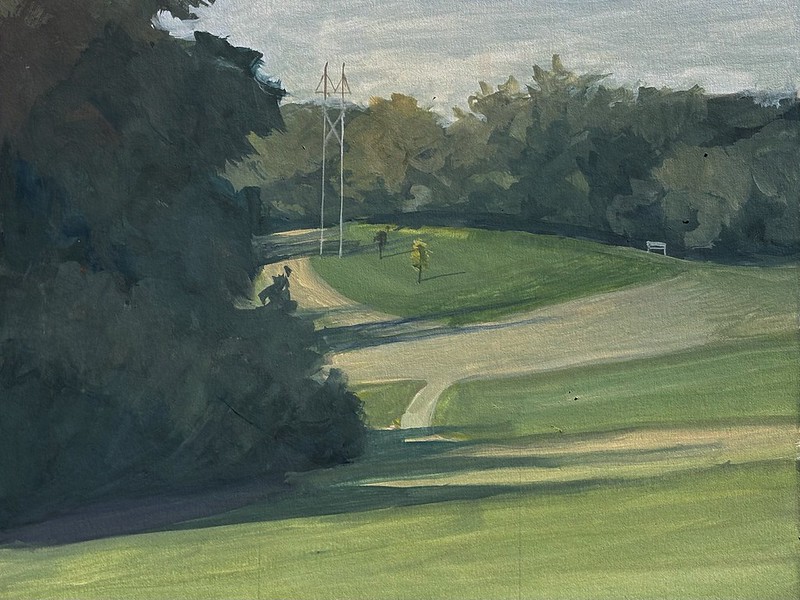
That afternoon’s quick paint was set up in a park. It’s a pleasant place with a dog park, cricket fields, mountain-bike trails, a disc golf course, and rolling hills of green fields and trees.
I set up in the shade and tried to let the place speak to me. I knew that if I waited for it, the large mass of trees I’d placed on one side of the painting would eventually cast long shadows curving up the bowl of green space opposite. Those shadows would help define the form of the land.
So I waited. And painted. It was a good painting.
Did it merit a purchase award? Nope. But that’s okay.
The next day I was even more fatigued. I set up near the historic town square, actually only a few hundred yards from my old studio. This time I wasn’t looking for anything particularly dramatic. I was more interested in a feeling of presence—the ambience of a typical Saturday morning in a small town.
The light was nice. The farmers market was in full swing. People were walking around with bags and coffee, stopping to talk with vendors and one another.
And, as tends to happen when I paint in a public place, people stopped at my easel to chat. I handed out a dozen cards, and a couple of people scanned the QR code on my pochade box. We talked about the painting, about the town, about what I was doing there.
There was plenty of time left in the day to complete a fourth painting. But I decided to hang it up. I wanted a chance to go home and take an afternoon nap before the evening awards ceremony.
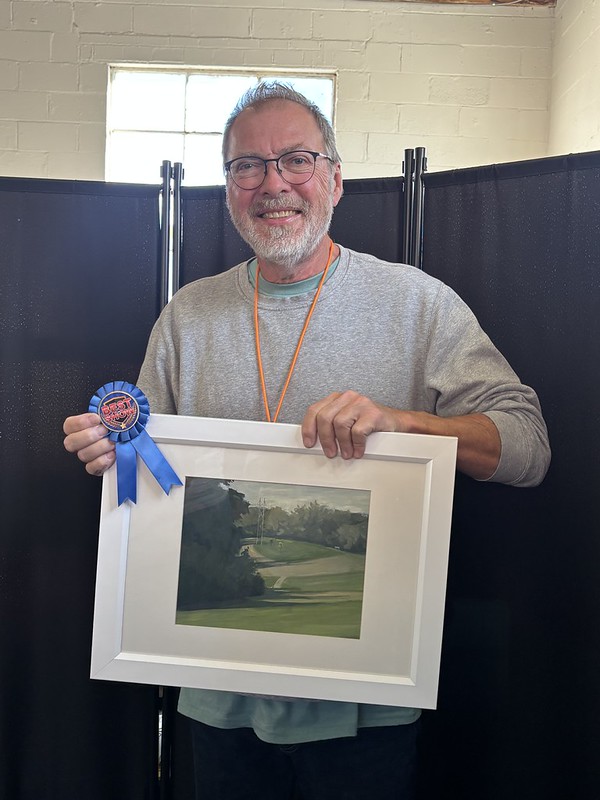
That turned out to be okay, too because a few hours later, my second painting, “Stocksdale Park,” was awarded Best of Show.
I took the day off today.
Maybe that was the best decision of the whole week. I’ve been thinking about that word—pause—and how easily I forget to do it. Sometimes the pause is intentional. You stop painting, step back, and look around because you suspect there might be something you’ve missed. Sometimes the pause is imposed on you. Rain. Heat. A bad painting. A hospital bed. A body that says, Nope. We’re done for today.
Either way, a pause changes the way you see things. And maybe that’s the bigger lesson for me. We spend so much time trying to get somewhere, find something, finish something. It’s easy to arrive at a place already knowing what we’re going to see.
Sometimes it’s worth stopping before we begin, because the place may have something else in mind.
The Old Catholic Church. 8 x 10 inches, traditional gouache on illustration board.
Stocksdale Park. 10 x 8 inches, traditional gouache on illustration board.
Both paintings are available for purchase. Reach out through the Contact form if you are interested.


Leave a comment